How Airports Make 57% of Revenue Without Flying a Single Plane
At an airport, a premium whiskey bottle that costs ₹2,600. The same bottle at your local store? ₹5,400. And you wonder how this is even legal?"
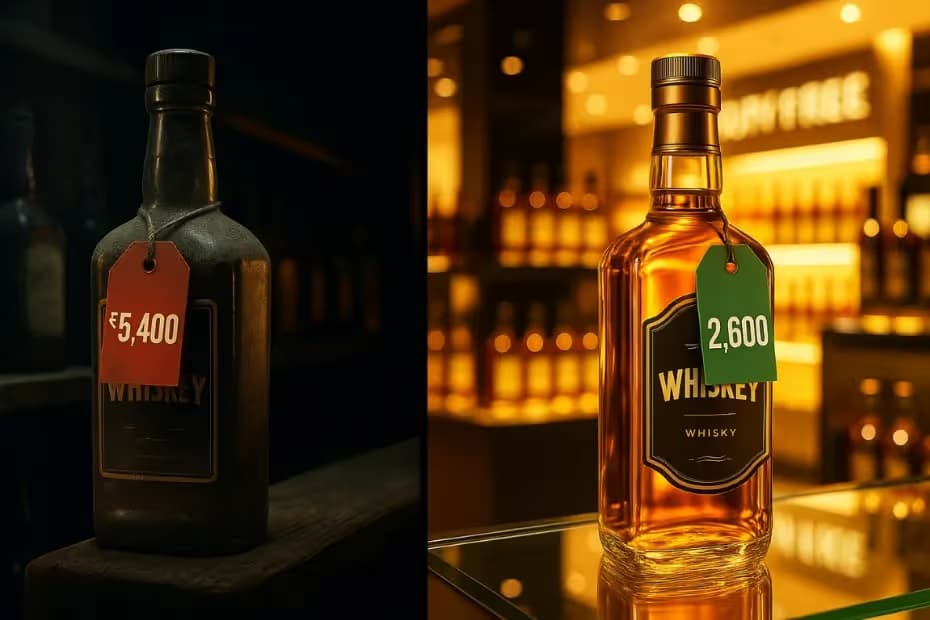
Here's what doesn't make sense: the government taxes literally everything. Your salary? Taxed. Your coffee? Taxed. That random fee on your phone bill? Also taxed.
But suddenly, when you're holding a boarding pass and standing in a designated retail zone, the same government that nickel-and-dimes you everywhere else goes, "Nah, this luxury perfume and premium scotch? You can have it tax-free."
What changed?
Nothing about you changed. You're still the same taxpayer. You're still on Indian soil. The shop is physically located in India, staffed by Indians, and sells products imported into India.
So why the sudden generosity?
The answer isn't about being nice to travelers. It's a genius legal loophole that started with seaplanes in 1940s Ireland, survived a Supreme Court battle in India, and continues to quietly make billions today.
Origin Story: When Airplanes Became "Ships"
Ireland, 1947: The Caterer Who Changed Everything
Picture this: World War II just ended. Transatlantic flights between America and Europe exist, but they're not what you think. We're talking about flying boats, massive seaplanes that needed to land on water to refuel.
Ireland, being neutral during the war, became the perfect pit stop. These seaplanes would land at Foynes (which later became Shannon Airport), refuel, and continue their journey.
Enter Brendan O'Regan, a local caterer working at the base.
O'Regan noticed something interesting: the passengers were wealthy, bored, and stuck in transit. They had money to spend but nowhere to spend it. He wanted to sell them Irish whiskey, woolens, and local goods, but there was a problem.
Taxes!!!!
If he sold them goods normally, the prices would include Irish customs duties and taxes. Not exactly appealing to Americans who could buy the same stuff back home.
So O'Regan had a radical thought...
The "Ships of the Air" Argument
He approached the Irish government with a fascinating legal comparison:
"When cruise ships sail in international waters, they're not in any country's territory. No country can tax goods sold on those ships. Now... what if we treated airplanes the same way?"
His logic was simple but brilliant:
→ International waters = no man's land = no taxes → Airplanes fly through international airspace = same principle → Airport transit zones = technically "borderless" areas
If you're not yet officially in a country (still in the transit zone), and you're about to leave on an international flight, then legally, you're in a gray area, a modern version of international waters.
The Irish government bought it.
In 1947, the world's first duty-free shop opened at Shannon Airport. It was an instant hit. Travelers couldn't believe they could buy expensive goods without the usual tax burden.
And just like that, a new industry was born.
When GST Tried to Kill Duty-Free
Fast forward to 2017. India introduces the Goods and Services Tax (GST), a revolutionary "One Nation, One Tax" system designed to simplify everything.
But it created a massive problem for duty-free shops.
The Government's Logic?
The GST Department looked at duty-free shops and said:
"Wait a minute. These shops are physically on Indian soil. They have Indian employees. They're selling goods imported into India. Why shouldn't they pay GST like every other retailer?"
Fair point, right?
They started sending notices demanding GST payments (often 18%+). If this went through, duty-free shops would lose their entire competitive advantage. Your ₹2,600 whiskey would suddenly become ₹5,400 again.
The duty-free industry panicked. This wasn't just about losing a tax break; it was an existential threat to their business model.
So they fought back. And it went all the way to the Supreme Court of India.
The Supreme Court's Genius Ruling
The Court had to answer one critical question:
"Is a duty-free purchase a domestic sale or an export?"
Here's where it gets brilliant.
The Court ruled that when you buy something duty-free, you are not technically the owner yet. You're just a courier. You're physically carrying the goods out of India, which makes it an export.
And exports? Not taxed.
Think about it:
- You buy the item in the transit zone (not yet "in" India)
- You carry it onto an international flight
- You take it to another country
From the government's pers
Loophole preserved. Duty-free saved.
Why Governments Happily "Lose" Billions?
Okay, but here's the real question: Why would the government voluntarily give up tax revenue?
On a ₹5,400 bottle of whiskey, the government is forgoing:
- ₹1,144 in customs duty (44%)
- ₹674 in GST (18%)
- ₹982 in state excise taxes
That's ₹2,800 in lost taxes per bottle. Multiply that across millions of passengers, and you're talking about billions in "lost" revenue.
So why do it?
Because It's Not Actually Lost—It's Redirected
Here's the genius part most people miss:
The government doesn't own the airports anymore. Most major Indian airports (Delhi, Mumbai, Bangalore) are public-private partnerships where:
- Private operators run the airport
- The government (Airports Authority of India) owns a stake (usually 26%)
- The government takes a revenue share (typically 39-46% of gross revenue)
Now here's where it gets interesting:
The Revenue Share Model
Delhi Airport shares ~46% of its gross revenue with the government.
Mumbai Airport shares ~39%.
And here's the kicker: 57% of Delhi Airport's revenue comes from non-aeronautical sources, that's retail, parking, food, and duty-free.
Duty-free alone makes up nearly half of that non-aeronautical revenue.
The Strategic Calculation
Let's break down the math:
Scenario A: Apply Full Taxes
- Whiskey costs ₹5,400 at duty-free
- Most travelers skip it and buy in Dubai/London instead
- India gets: ₹0 in taxes, ₹0 in revenue share
Scenario B: Tax-Free
- Whiskey costs ₹2,600 at the duty-free
- Traveler buys it in India
- The shop makes a massive profit margin
- The government takes a 46% revenue share from the airport
- India captures: Economic activity + jobs + profit share
The government makes MORE money by not taxing it.
Why? Because if they taxed it, the sale wouldn't happen in India at all. It would happen in Singapore, Dubai, or London, and India would get nothing.
By keeping it tax-free, India captures the transaction, generates employment, and takes a cut of the profits without having to administer the taxes directly.
It's not a loophole the government tolerates. It's a loophole the government engineered.
Where Your Money Actually Goes?
Let's look at what you're actually paying (or not paying):
The Price Anatomy of a Whiskey Bottle
| Cost Component | Retail Store (Bangalore) | Duty-Free (Airport) |
| Base Price + Margin | ₹2,600 | ₹2,600 |
| Customs Duty (~44%) | + ₹1,144 | ₹0 (Exempt) |
| GST (18%) | + ₹674 | ₹0 (Exempt) |
| State Excise/Taxes | + ₹982 | ₹0 (Exempt) |
| FINAL PRICE | ₹5,400 | ₹2,600 |
| YOUR SAVINGS | 0% | ~52% |
You're not getting a "discount." You're getting the actual price before the government takes its cut, three times.
Why Every Airport Does This?
This isn't just an Indian thing. Duty-free is a global phenomenon worth over $80 billion annually.
Why? Because airports realized something crucial:
Passengers are a captive audience with disposable income and time to kill.
And if you can remove the psychological barrier of taxes, they'll spend. A lot.
- Dubai Airport makes over $2 billion annually from duty-free
- Singapore Changi turns duty-free into an experience with free tastings and lounges
- London Heathrow dedicates entire terminals to retail
The model works everywhere because the economics are universal:
- Remove taxes → Lower prices → Higher sales → Bigger profits → Government takes a share
Everyone wins. Except maybe your willpower.
The Last Sip
So next time you're at the airport, about to buy that ₹2,600 bottle of whiskey instead of paying ₹5,400 at a local store, remember:
- You're not getting a "discount"—you're buying at the pre-tax price
- You're not exploiting a loophole—you're participating in a government-designed economic strategy
- You're not just a customer—you're legally classified as a courier exporting goods
- The government isn't losing money—they're redirecting it through revenue shares
The genius isn't in the loophole. It's in making everyone think it's a loophole.
The government gets its cut. The airport makes massive profits. You feel like you got a deal.
And that ₹2,800 in "lost" taxes? It never left the system. It just moved from the tax department's ledger to the airport authority's revenue statement.
Welcome to the world of duty-free, where 1940s maritime law, Supreme Court rulings, and clever accounting create the illusion of tax-free luxury.