Understanding Beer ABV - A Simple Guide to Alcohol Strength in Beer
ABV stands for Alcohol By Volume - the percentage of alcohol in your beer. This simple guide explains what ABV means, why it matters, and how to drink at any strength mindfully.
If you have ever looked at a beer bottle and noticed the small percentage printed on the label - 4.8%, 7.2%, 8% - you have seen ABV. But what does it actually mean? How does it affect your body? And why does it matter which number you are looking at before you open the bottle?
This guide answers all of that in plain, clear language. No jargon. No intimidation. Just the information you actually need.
What Is ABV?
ABV stands for Alcohol By Volume. It is the standard measurement used across the world to express how much alcohol is in a drink.
Specifically, it tells you what percentage of the total liquid is pure alcohol (ethanol). So a beer with 5% ABV contains 5 millilitres of pure alcohol in every 100 millilitres of beer.
That is it. The number is simply a percentage. The higher it is, the more alcohol is in your drink.
How Much Alcohol Is Actually in Your Beer?
Knowing the ABV is useful. But what makes it really meaningful is calculating how much alcohol is in the specific serving you are drinking.
The formula:
Volume (ml) × ABV (%) × 0.789 (density of ethanol) = Grams of Alcohol For everyday purposes, a simpler mental shortcut:
A 330ml beer at 5% ABV contains approximately 13 grams of pure alcohol. A 650ml beer at 5% ABV contains approximately 26 grams of pure alcohol. A 650ml beer at 8% ABV contains approximately 41 grams of pure alcohol.
This is why the size of your serving matters as much as the ABV number. A small glass of a strong beer and a large bottle of a light beer can contain similar amounts of alcohol.
ABV Across India's Beer Range
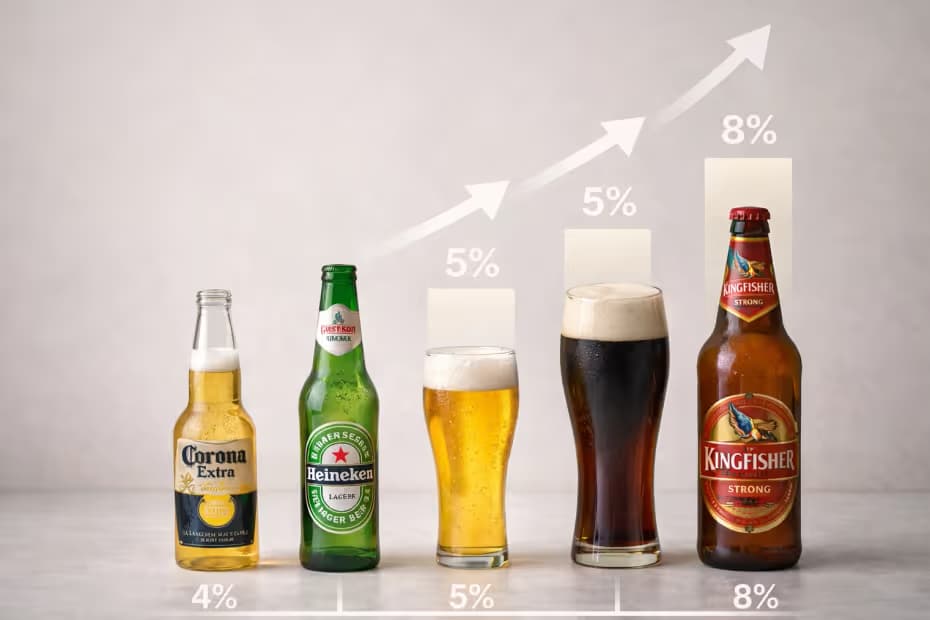
Here is how India's most common beers stack up on the ABV scale, from lightest to strongest:
Beer Styles, ABV & What They Mean
| Beer | Style | ABV | What This Means |
| Heineken 0.0 | Non-alcoholic | 0% | No alcohol at all |
| Budweiser 0.0 | Non-alcoholic | 0% | No alcohol at all |
| Heineken Silver | Light Lager | ~4% | One of the lightest options |
| Corona Extra | Mexican Lager | ~4.5% | Light, very refreshing |
| Kingfisher Premium | Pale Lager | ~4.8% | India's standard benchmark |
| Tuborg Green | Pale Lager | ~4.8% | Very similar to Kingfisher Premium |
| Bira 91 White | Wheat Beer | ~4.7% | Approachable, fruity |
| White Rhino Hefeweizen | Wheat Beer | ~4.8% | Aromatic, light-moderate |
| Bira 91 Blonde | Blonde Lager | ~4.9% | Craft, slightly more character |
| Budweiser | American Lager | ~5% | Smooth, neutral |
| Heineken Lager | European Lager | ~5% | Premium, hop-forward |
| Simba Lager | Craft Lager | ~5% | Fresh, fuller craft quality |
| White Rhino Craft Lager | Craft Lager | ~5% | Himalayan-brewed craft |
| Kingfisher Ultra | Premium Lager | ~5% | Smoother, slightly premium |
| Bira 91 Boom | Strong Lager | ~6.6% | Noticeable step up |
| Budweiser Magnum | Strong Lager | ~6.5% | Smooth but stronger |
| Tuborg Strong | Strong Lager | ~7.2% | Popular in North India |
| Haywards 5000 | Strong Lager | ~7% | Classic strong lager |
| Simba Stout | Stout | ~7% | Dark, complex, stronger |
| Kingfisher Strong | Strong Lager | ~8% | High end of common range |
| Godfather Super Strong | Super Strong | ~7.5–8% | Maximum commercial strength |
Why ABV Matters: The Practical Reality
Many casual drinkers know about ABV in theory but do not apply it in practice. This gap between knowledge and behaviour is where most unintended over-drinking happens.
Here is what ABV means in practical, daily-life terms:
One 650ml bottle of Kingfisher Premium (4.8%) contains approximately 25 grams of alcohol.
One 650ml bottle of Kingfisher Strong (8%) contains approximately 41 grams of alcohol.
You are drinking what looks like the same bottle. But the Strong variant contains 65% more alcohol than the Premium.
If you typically drink two 650ml Kingfisher Premiums over an evening and feel fine the next morning, two 650ml Kingfisher Strongs will feel very different, because you have consumed significantly more alcohol than you intended.
This is the most important practical takeaway from understanding ABV: the serving size is as important as the number.
How ABV Affects Your Body
Alcohol enters your bloodstream through the walls of your stomach and small intestine. The speed at which it does so is affected by several factors:
Food intake - Eating before or while drinking significantly slows alcohol absorption. A full meal can reduce peak blood alcohol concentration by up to 50%.
Body weight and composition - Larger bodies and more muscle mass dilute alcohol more effectively.
Pace of drinking - Your liver processes approximately one standard drink per hour. Drinking faster than this means alcohol accumulates in your blood.
Hydration - Alcohol is a diuretic (it makes you urinate more). Drinking water alongside beer slows dehydration and dilutes alcohol's effects.
Individual variation - Some people process alcohol faster than others due to genetics and enzyme levels. What happens as alcohol enters your system:
1–2 standard drinks: Mild relaxation, slight lowering of inhibitions. Many people feel social and conversational. This is where most casual drinkers prefer to stay.
3–4 standard drinks: Coordination begins to be affected. Reaction times slow. Decision-making becomes less reliable. Driving is compromised at this level even if you feel "fine."
5+ standard drinks: Significant impairment. Speech, balance, and judgement are noticeably affected. Memory formation begins to be compromised.
What is a "standard drink" in India? India does not have an official standard drink definition, but a useful approximation is: one standard drink = 330ml of 5% beer = approximately 14 grams of pure alcohol.
The Strong Beer Warning Most Drinkers Ignore
India's strong beer culture is widespread and deeply normalised in certain regions. Brands like Haywards 5000, Godfather Super Strong, and Kingfisher Strong are consumed casually by millions of people who drink them at the same pace as they would a standard lager.
This is where ABV awareness becomes genuinely important.
A single 650ml bottle of Godfather Super Strong (8%) contains approximately the same amount of alcohol as two and a half 330ml cans of a standard 5% lager. Drink two of these bottles over an evening, and you have consumed the alcohol equivalent of five standard cans of beer.
This is not a reason to avoid strong beers. It is a reason to drink them knowingly, slowly, and with food - not at the same pace and quantity as a light lager.
→ Lager vs Strong Beer - What Is the Difference and Which Should You Try?
ABV and Non-Alcoholic Options
Worth noting: several major brands now offer non-alcoholic or very low-alcohol alternatives. Heineken 0.0 and Budweiser 0.0 (0% ABV) are genuinely well-made products that replicate much of the beer experience without any alcohol.
These are excellent options for:
- Designated drivers
- Drinkers who want to participate socially without consuming alcohol
- Evenings when you want the refreshment of beer with none of the alcohol effects
- Mindful drinkers who want to alternate alcoholic and non-alcoholic drinks
Non-alcoholic beer is not a compromise. It is a legitimate choice, and the quality of these products has improved dramatically in recent years.
Practical ABV Rules for Casual Drinkers
Rule 1: Know before you open. Check the ABV before you start drinking. The difference between 4.8% and 8% is significant. Knowing this prevents surprises.
Rule 2: Adjust serving size by ABV. If you normally drink two 650ml bottles of a standard lager, consider drinking one (or at most one and a half) 650ml bottles of a strong lager. The alcohol math matters.
Rule 3: Pair ABV with occasion. Light beers (4–5%) for casual social occasions and hot-weather refreshment. Stronger beers (6–8%) for smaller quantities, on specific occasions, with full meals.
Rule 4: Match pace to ABV. A 5% beer consumed over 45 minutes is manageable. An 8% beer consumed over the same 45 minutes delivers 60% more alcohol to your system. Slower pace with stronger beer.
Rule 5: Always eat, always hydrate. Non-negotiable regardless of ABV. Food and water make every beer experience safer and more enjoyable.
A Note on Mixing Beers of Different ABV
Sometimes at a social occasion you switch between a standard lager and a strong beer, perhaps a Tuborg Green to start and a Tuborg Strong later. This is fine, but be conscious of the accumulation.
Tracking how much you have drunk by bottle count becomes misleading when ABVs vary. Better to track by estimated total alcohol consumed - which requires knowing the ABV of everything you have had.
This is not about being anxious or over-cautious. It is simply about being the drinker who knows what they are drinking.
The OccasionalDrinker Philosophy on ABV
At OccasionalDrinker.com, we believe the most important word in beer drinking is awareness.
You do not need to be afraid of strong beer. You do not need to limit yourself to the lowest ABV option on the menu. You simply need to understand what you are drinking, drink it accordingly, and make choices that keep you healthy, safe, and genuinely enjoying the experience.
The drinker who has two Heineken Lagers and remembers every conversation from the evening has had a better drinking experience than the one who consumed six strong beers and cannot. The pleasure is in the taste, the company, and the context - not in the amount consumed.
ABV is information. Use it.
Responsible Drinking - The Non-Negotiables
Regardless of ABV, alcohol level, or occasion, these rules are absolute:
- Never drink and drive. Even one standard drink affects reaction times and judgement.
- Only drink if you are of legal drinking age — 18 in most Indian states; 21 in some. Know your local law.
- If you feel unwell, stop immediately. Your body's signals are more reliable than any guide.
- Be aware of your company. If someone around you appears to have had too much, prioritise their safety over the occasion.
- Pregnant individuals should not consume alcohol. This is medical consensus.
OccasionalDrinker.com is for adults of legal drinking age only. We prioritise education, mindfulness, and responsible consumption in everything we publish.