Bira 91 Is Fighting for Survival - And Employees Are Paying the Price
Bira 91 and the Collapse of a Craft Beer Dream. From Craft Beer Darling to Cash Crisis: What Happened to Bira 91?
From startup poster child to salary protests, expired beer stock, and a founder under pressure
For years, Bira 91 was positioned as the cool face of India’s modern beer culture. Bright cans, quirky branding, taproom experiments, and aggressive expansion helped the company become one of the country’s most recognizable craft beer success stories.
Now, the same company is battling unpaid salaries, collapsed investor confidence, operational paralysis, and a deep cash crisis that insiders describe as a near-survival situation.
What was once a planned 2026 IPO story has rapidly turned into one of the biggest cautionary tales in India’s alcobev startup ecosystem.
₹748 Crore Losses, Falling Sales, and a Business Burning Cash
The financial damage inside B9 Beverages has become difficult to ignore.
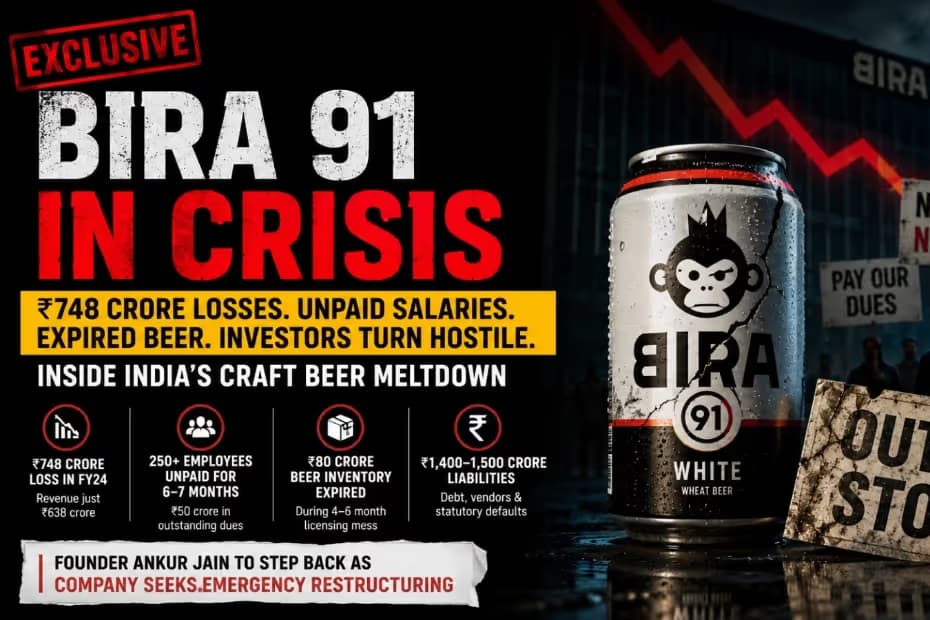
According to FY24 disclosures, the company posted a staggering ₹748 crore net loss against revenue of ₹638 crore. Total accumulated losses have reportedly crossed ₹1,900-₹2,100 crore, severely eroding the company’s financial base.
At the same time, beer volumes sharply declined. Bira’s annual sales reportedly fell from nearly 9 million cases in FY23 to around 6-7 million cases in FY24.
Investor confidence has also collapsed. The company’s unlisted share price reportedly crashed almost 70%, falling from around ₹825 in 2022 to nearly ₹248.
For a brand once considered India’s breakout craft beer giant, the fall has been dramatic.
Employees Say Salaries Haven’t Arrived for 6-7 Months
The crisis is no longer just financial spreadsheets and investor concerns. It has now become a full-scale employee issue.
More than 250 current and former employees reportedly remain unpaid for periods stretching up to six or seven months. Outstanding dues, including salaries, reimbursements, and settlements, are estimated at roughly ₹50 crore.
The situation became more serious after employees allegedly discovered that TDS and Provident Fund deductions were being made from salaries without deposits reaching government accounts for over a year.
Meanwhile, the company’s workforce has reportedly collapsed from around 700 employees to roughly 200–260 after aggressive cost-cutting and layoffs.
Former employees also claimed Bira’s corporate office became largely non-functional after rent payments were missed.
In early 2026, matters spilled into public view when employees staged a peaceful protest outside founder Ankur Jain’s Delhi residence, citing missed EMIs, unpaid medical expenses, and severe personal financial distress.
Some employees also petitioned government authorities and institutional investors, demanding a forensic audit and leadership intervention.
The “One-Word” Mistake That Triggered Chaos Across 27 States
Insiders say one regulatory issue became the turning point.
In late 2022, Bira’s shareholder count crossed India’s legal private-company threshold of 200 shareholders. That forced the company to remove the word “Private” from its corporate name and transition from “B9 Beverages Private Limited” to “B9 Beverages Limited.”
On paper, the change looked minor.
Operationally, it became a disaster.
Because alcohol licensing in India is controlled state by state, excise departments allegedly treated the renamed entity as an entirely new company. That meant Bira suddenly had to reapply for manufacturing, wholesale, retail, and brand registrations across 27 states.
The process reportedly took 4–6 months.
During that period, Bira’s products disappeared from shelves in key markets including Delhi NCR, Haryana, and Karnataka. Over ₹80 crore worth of beer inventory allegedly expired while sitting in warehouses.
And in the alcohol business, empty shelf space rarely stays empty for long.
Rivals Took Over While Bira Was Missing
As Bira struggled with licensing paralysis, competitors rapidly occupied its retail and bar placements.
Premium lagers, craft labels, and regional beer brands moved into the exact urban spaces where Bira once dominated.
For a category driven heavily by visibility and availability, disappearing for months proved devastating.
Industry observers say the company lost not only revenue but also momentum, retailer confidence, and consumer habit.
Debt Piled Up After Funding Failed
Bira’s aggressive expansion model depended heavily on continuous fundraising.
But as revenues slowed and operations stalled, critical funding support reportedly collapsed.
A major ₹500 crore debt infusion from BlackRock allegedly failed to materialize, worsening the liquidity squeeze.
Today, total liabilities are estimated between ₹1,400–₹1,500 crore, including:
- Around ₹950 crore in debt
- Nearly ₹300 crore owed to vendors
- Roughly ₹150 crore in statutory defaults
Vendors reportedly began halting raw material supplies due to unpaid dues.
Even emergency discounted rights issues worth around ₹85 crore in mid-2025 were allegedly consumed almost entirely by immediate debt repayments instead of business recovery.
Investors Tighten Control as Founder Faces Pressure
The financial pressure has also fractured relationships with institutional backers.
Tensions escalated after lenders and investors reportedly seized operational control of The Beer Cafe, a pub chain acquired by Bira in 2022.
The takeover allegedly happened after Bira defaulted on loans secured against Beer Cafe shares. Investors moved to protect the subsidiary from becoming entangled in a larger bankruptcy risk.
Founder Ankur Jain has reportedly challenged the move in the Delhi High Court.
At the same time, major investors are now said to be demanding professional external management before approving additional capital support.
As a result, Jain has reportedly agreed in principle to step back from operational control while restructuring discussions continue.
What Happens Next?
Bira 91 is now reportedly exploring restructuring options, emergency asset sales, and fresh management-led revival plans in an attempt to secure immediate working capital.
But the company’s biggest challenge may no longer be only financial.
It is trust.
- Trust from employees waiting for salaries.
- Trust from vendors waiting for payments.
- Trust from investors waiting for stability.
And trust from consumers who once saw Bira as the future of Indian beer culture.
Today, the company that helped define India’s modern craft beer boom is fighting to survive it.