Bihar Liquor Ban 2025: Health, Law, and Political Aspects
Learn how Bihar’s liquor ban improved health, reduced crime, and shaped politics, turning prohibition into one of the state’s most debated and defining policies.
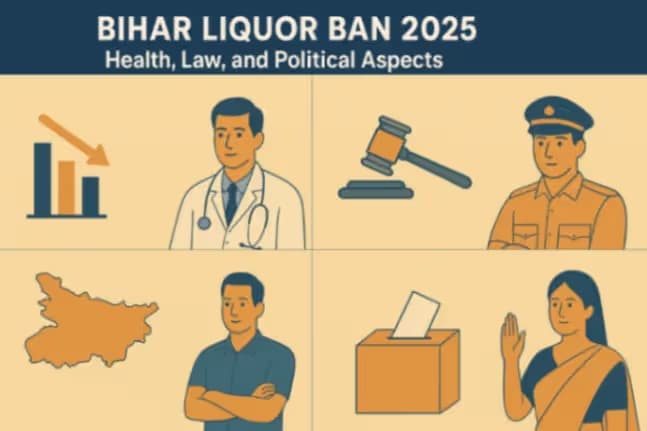
After nearly a decade of complete prohibition, Bihar’s liquor ban has moved beyond being just a social reform, it has become a story of health recovery, reduced violence, and powerful political symbolism.
The Hidden Health Transformation
One of the most overlooked outcomes of the liquor ban has been its impact on public health. A 2023 study published in ScienceDirect revealed a steady fall in alcohol-related diseases among men in Bihar. Doctors report fewer cases of alcohol poisoning, liver damage, and domestic injuries caused by alcohol-fueled violence.
The state’s health department has also noted a clear decline in hospital admissions linked to drinking, saving crores in public health expenditure. Families, especially in rural Bihar, are now spending more on nutrition and children’s education instead of alcohol. Even though illegal trade persists in some pockets, overall consumption has fallen drastically, leading to better productivity, stronger households, and a more focused workforce.
Law and Order: A Changing Landscape
One of the biggest criticisms of prohibition has been the rise of smuggling and illicit sales. But the data tells a more nuanced story. A 2021 study by Cornell University found that violent crimes have significantly dropped in many districts since the ban began. Police records also show a noticeable fall in road accidents linked to drunk driving.
To tackle the smuggling issue, Bihar has adopted technology-driven enforcement, using drones, CCTV networks, and inter-state coordination with Uttar Pradesh, West Bengal, and Nepal border regions. These efforts have started to create a more disciplined and law-abiding environment, even in areas previously known for alcohol-related disturbances.
A Regional Comparison: What Makes Bihar Different
When placed alongside its neighbors, Bihar’s commitment to prohibition stands apart. Jharkhand’s short-lived ban collapsed under political pressure, while Uttar Pradesh and West Bengal continue to expand their liquor industries to boost tax revenues.
Critics argue that Bihar has lost excise revenue, but supporters see a different kind of gain, social peace, safer streets, and empowered women. Cities like Kolkata and Lucknow now face rising binge drinking and drunk driving cases, reinforcing the belief among many Biharis that prohibition protects future generations from addiction and its social costs.
Politics of Prohibition: A Symbol of Women’s Empowerment
In Bihar’s political landscape, prohibition isn’t just a policy, it’s an identity. For Chief Minister Nitish Kumar, it remains one of his proudest achievements. The move continues to receive strong support from women, who see the ban as a shield against domestic abuse and financial instability.
Even opposition leaders like Tejashwi Yadav criticize the implementation but stop short of demanding its reversal. During the 2020 elections, surveys revealed that the liquor ban was a top reason women voted for Nitish Kumar. As the 2025 elections approach, that sentiment remains unchanged. The policy has become a symbol of dignity, safety, and respect for women, turning prohibition into one of Bihar’s defining political legacies.
FAQs
1. Has the liquor ban improved public health?
Yes. Studies show fewer alcohol-related diseases, injuries, and hospital admissions across Bihar.
2. Did crime rates change after prohibition?
Yes. Police data indicates fewer violent crimes and road accidents linked to drunk driving.
3. How does Bihar’s policy differ from other states?
While others focus on liquor revenue, Bihar prioritizes health, safety, and women’s welfare.
4. Is prohibition still politically important in 2025?
Absolutely. It remains central to Bihar’s politics and continues to have strong support, especially among women voters.
5. What are the main challenges for law enforcement?
Smuggling and cross-border illegal trade still exist, but surveillance and coordination have strengthened enforcement.