Delhi Liquor Booking App Row: AAP Demands Withdrawal, Officials Say Project Was Cleared During AAP’s Tenure
AAP has given the Delhi government 24 hours to scrap DSIIDC’s Delhi Liquor Booking app, but officials say the project was approved in December 2024, when AAP was in power. Here’s how the app works, who cleared it, and how many people use it.
New Delhi, November 1, 2026: A mobile app that lets people pre-book and pay for liquor at government-run shops has become Delhi’s latest political flashpoint. The Aam Aadmi Party (AAP) has demanded that the Rekha Gupta-led BJP government withdraw the Delhi Liquor Booking app. Officials of the state corporation running it say the project was first cleared in December 2024, when AAP was still in power.
The row has been reported by Open Magazine, The New Indian Express and The Hindu, among others. Here is what we know so far.
What is the Delhi Liquor Booking app?
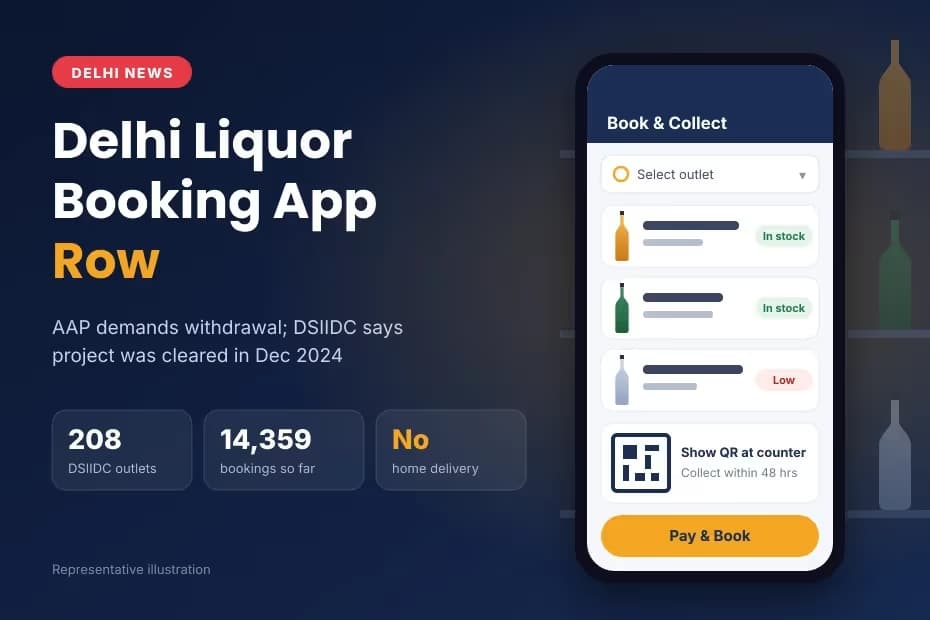
The app was developed by the Delhi State Industrial and Infrastructure Development Corporation (DSIIDC), one of four government agencies that run liquor retail in the capital. It lets customers:
- check whether a brand is in stock at a chosen outlet
- pick the bottle size and quantity
- pay online
- collect the order from that shop within 48 hours by showing a QR code at the counter
Only buyers aged 25 and above can use it. Orders can be cancelled before pickup, but liquor cannot be returned once collected.
Does the app deliver liquor at home?
No. The service does not offer home delivery, despite much of the political messaging around it. It is a book-and-collect facility, and customers still have to visit the shop in person.
Its reach is also limited. It covers DSIIDC’s 208 outlets, while Delhi has more than 700 government-run liquor shops operated by DSIIDC, DTTDC, DSCSC and DCCWS. Shops run by the other three corporations are not included yet.
Why is AAP opposing it?
Delhi AAP president Saurabh Bharadwaj gave the government a 24-hour ultimatum to scrap the facility and warned of a mass agitation if it did not. He accused the government of worrying about queues outside liquor shops while patients wait for medicines and residents struggle for basic services.
Bharadwaj coined the slogan “Har-Har Rekha, Ghar-Ghar Theka” to target the chief minister. He said AAP would seek the resignation of minister Manjinder Singh Sirsa if the app stayed, and demanded an apology to the women of Delhi. Senior AAP leader Manish Sisodia also criticised the move, saying the government should prioritise health and education.
Who approved the app: AAP or BJP?
According to a status note issued by DSIIDC on October 28:
- December 13, 2024: DSIIDC management approved development (AAP government in office)
- January 2, 2025: Work order issued for development
- November 2025: Service rolled out after trials (BJP government in office)
- September 6, 2026: QR-based microsite launched, opening access to iPhone users
As The Hindu reported, officials maintain the app was permitted under the previous government. BJP spokesperson Praveen Shankar Kapoor has also blamed the earlier AAP administration.
AAP rejects this. Bharadwaj has challenged officials to produce any file bearing an AAP minister’s signature and has called for a Vigilance inquiry. Approval by a corporation’s management is not the same as approval by a minister, and neither side has made the full file public so far.
How many people are using it?
DSIIDC’s status note shows the app is still small:
- 3,629 transactions worth ₹12.93 lakh between November 10, 2025 and March 31, 2026
- 10,730 transactions worth ₹29.90 lakh from April 1, 2026 onwards
- Total: 14,359 transactions worth ₹42.83 lakh
For comparison, DSIIDC sold liquor worth about ₹2,682 crore across its shops in 2025-26. App bookings are only a tiny fraction of that.
Why did DSIIDC launch it?
The corporation says the aim was to cut queues, improve transparency and stop “brand pushing,” where staff steer buyers towards particular labels. Showing live stock in the app gives customers more information before they reach the counter, and each sale leaves a digital record.
The bigger picture
Liquor policy has been a sensitive issue in Delhi since the AAP government’s 2021-22 excise policy, which handed retail to private players and was later withdrawn. Government corporations took back liquor retail from September 1, 2022. Rules amended in 2021 had also allowed home delivery through licensed apps, but that system was never put into operation.
What happens next?
As of this report, the government has not announced any withdrawal of the app. Three questions remain open:
- Who signed off on the project at the political level?
- How are age checks enforced at pickup?
- Will AAP’s protest move to the streets?